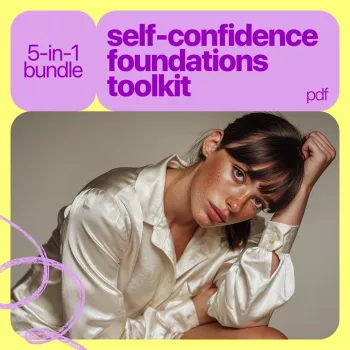
Build Real Confidence: Self-Confidence Foundations Toolkit

Self-Confidence Foundations Toolkit: a practical way to build confidence you can repeat
Confidence isn’t a personality type—it’s a set of skills you can learn, practice, and strengthen. Our team built the Self-Confidence Foundations Toolkit – Build Confidence & Self-Esteem with Expert Guides for you if you want a clear, guided way to build steadier self-esteem, speak up with less second-guessing, and follow through on goals without relying on temporary motivation.
Instead of “try to feel confident,” this toolkit helps you build confidence through structure: small commitments, consistent action, and a repeatable routine that turns progress into something measurable.
What “confidence foundations” actually means
When we say “foundations,” we mean the underlying habits that hold you up in real moments—not hype strategies that disappear the minute stress shows up.
- Durable habits over quick boosts: self-talk, boundaries, follow-through, and emotional regulation are the building blocks.
- Confidence through evidence: small commitments kept consistently become proof doubt can’t easily argue away.
- Separate self-worth from performance: you learn to evaluate actions without turning outcomes into a verdict on your value.
- Reduce the fear loop: you practice steps that make discomfort workable rather than threatening.
Who this toolkit is built for
- You feel capable on paper, but hesitate in the moment—meetings, dates, interviews, or social settings.
- You’re rebuilding self-esteem after a setback (career shifts, relationship changes, burnout, health challenges).
- You’re a high-achiever who overthinks, people-pleases, or gets stuck in perfectionism and procrastination.
- You want a guided framework—less guessing, more “do this next.”
- You’re ready to practice confidence in small, sustainable steps instead of forcing a personality overhaul.
What’s inside the Self-Confidence Foundations Toolkit
Our goal was to bring expert-led guidance into a practical format so your progress feels structured, trackable, and repeatable.
- Expert-guided lessons that break confidence into trainable parts: thoughts, behaviors, and emotional patterns.
- Exercises and prompts that turn insight into action—reflection, planning, and real-world practice.
- Tools to spot confidence “leaks” like negative self-talk, avoidance, comparison, and boundary gaps.
- A repeatable practice loop for choosing a goal, tracking wins, and adjusting without self-criticism.
- Support for private and visible confidence—how you feel internally and how you communicate externally.
How to use it for real-world change (a simple routine that works)
The biggest shift usually comes when you stop trying to fix everything at once and start building proof in one “confidence arena.” Pick one starting point:
- Voice: speaking up, asking questions, sharing opinions.
- Body: presence, posture, nervous-system regulation.
- Decisions: less second-guessing, fewer re-checks.
- Boundaries: saying no, making clear asks, reducing resentment.
Two-Week Confidence Practice Plan (adapt to any goal)
| Day | Focus | Practice (10–20 min) | Real-World Step (5–15 min) | Win to Record |
|---|---|---|---|---|
| 1 | Baseline | Define one situation that triggers low confidence | Write a one-sentence goal for the next 14 days | Clear goal statement |
| 2 | Self-talk | Spot top 3 recurring doubts | Rewrite each doubt into a realistic coaching statement | 1 helpful reframe used today |
| 3 | Body & presence | Choose one posture/breath cue | Use the cue before a conversation | Noticed calmer start |
| 4 | Micro-courage | List 5 small “avoidance” tasks | Do the easiest one | Task completed despite discomfort |
| 5 | Boundaries | Identify one “yes” that should be a “no” | Draft a polite boundary line | Boundary script prepared |
| 6 | Social confidence | Plan 2 conversation openers | Use one opener | Initiated interaction |
| 7 | Review | Note patterns (triggers, wins, stuck points) | Choose next week’s single focus | 1 insight written down |
| 8 | Decisions | Set decision rules (time limit + criteria) | Make one decision within the time limit | Decision made without spiraling |
| 9 | Assertiveness | Practice “clear ask” format | Make one clear request | Asked directly |
| 10 | Exposure | Pick a slightly harder step | Do the step with a recovery plan | Discomfort handled safely |
| 11 | Self-trust | List 3 promises kept recently | Keep one tiny promise today | Self-trust proof |
| 12 | Handling feedback | Separate facts from interpretation | Ask one clarifying question if needed | Responded without collapsing |
| 13 | Confidence under pressure | Create a pre-event routine (2–3 steps) | Use the routine before a challenge | Routine completed |
| 14 | Integration | Review wins and next growth edge | Set a 30-day continuation plan | Next steps scheduled |
Core skills the toolkit helps strengthen
How to know it’s working (signs that show up first)
Product details and where to get it
- Product: Self-Confidence Foundations Toolkit – Build Confidence & Self-Esteem with Expert Guides
- Availability: in stock
- Price: $288.99 (USD)
- Best for: structured, guided confidence-building with practical exercises and repeatable routines
- Next step: choose one confidence arena and run the two-week plan before expanding your focus
Other in-stock tools for structured progress
- Is Carsharing the Right Choice for You – Practical Guide Exploring for Smarter, Cheaper, Greener Transportation Decisions
- Easy Holiday Potluck Bundle on a Budget – 3-in-1 Digital Download
Helpful, research-based reading (optional support)
- American Psychological Association (APA) – Building your resilience
- National Institute of Mental Health (NIMH) – Anxiety Disorders
- Mayo Clinic – Self-esteem: Take steps to feel better about yourself
FAQ
How long does it take to feel more confident using this toolkit?
Many people notice early progress as faster action and less overthinking, even before they “feel” confident. Start with two weeks of consistent practice, then set a simple 30-day continuation plan so your gains become stable.
Is this toolkit better for self-esteem or for speaking up in real situations?
It supports both, because self-esteem and behavior reinforce each other. You build internal confidence (self-talk, worth, recovery) while practicing external confidence (assertiveness, boundaries, action) in real situations.
What if motivation drops after a few days?
Use a minimum baseline you can keep on low-energy days—5 to 10 minutes is enough to maintain momentum. Track proof-building actions (what you did) instead of waiting to feel ready, and keep the next step small enough to complete.















Leave a comment